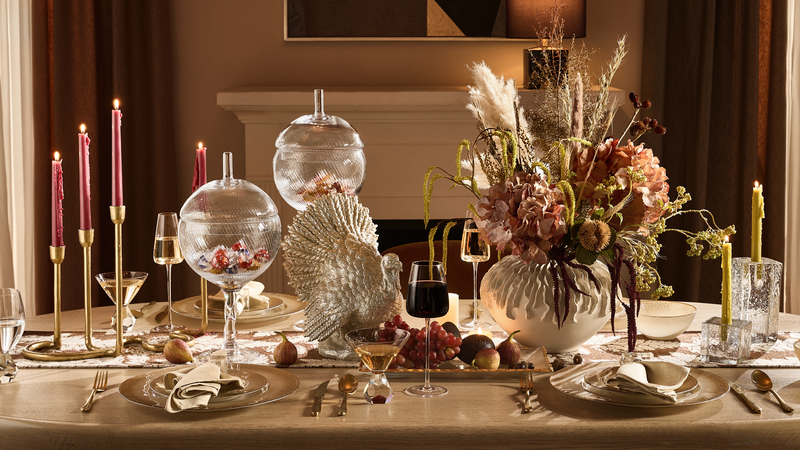
Most homes decorate the mantel and the table as two separate errands. The mantel goes up the weekend after Thanksgiving in a burst of garland and good intentions. The table gets set an hour before people arrive, out of whatever is left in the box. By the time everyone sits down, the two halves of the room are having different conversations.
They should be having one.
The mantel is what everyone sees from the doorway, and it stays up for six weeks. The table is what everyone sits at, and it lives one evening at a time. Decide the palette on the mantel. Spend it on the table. The eight looks below pair Christmas table decorations with the mantel above them, so you can watch that order do the work.
In this article
- Why the mantel sets the rules
- How to decorate a mantel for Christmas
- Four Christmas mantel ideas, each built on one statement piece
- How to decorate a table for Christmas
- Four Christmas tablescapes, each anchored by a centerpiece
- Making the mantel and the table read as one room
- Mantel decor ideas that outlast the holidays
- Frequently asked questions
Why the mantel sets the rules
A mantel is a shelf at eye level with a wall behind it, which makes it the most visible surface in the house and the most forgiving. Nothing on it has to move for dinner. Nothing has to survive a gravy boat.
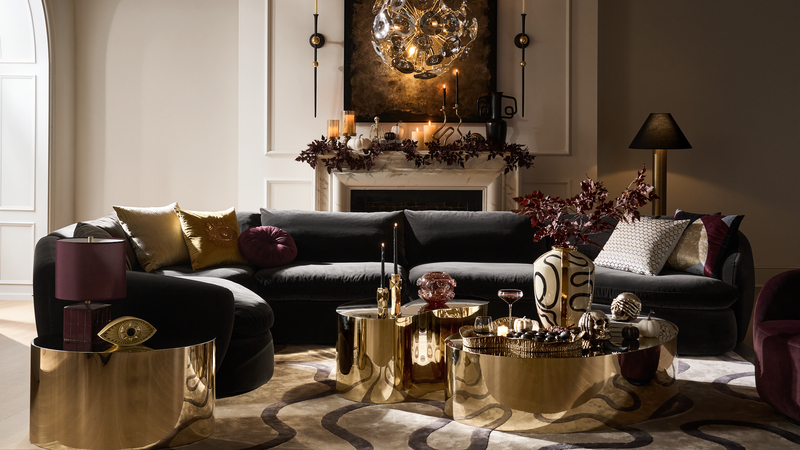
That permanence is why it goes first. Whatever finish you commit to up there, warm gold or graphite or something colder and whiter, becomes the rule everything downstream follows. Choose it once, in the place you will look at it longest, and the table stops being a separate decision.
It also means the mantel can carry scale the table cannot. A five-foot nutcracker is a personality on a mantel. On a dining table it is an obstacle. Scale is the first thing to check when you shop for Christmas décor and the last thing most people think about.
How to decorate a mantel for Christmas
Start with one anchor above the mantel, usually a mirror or a wreath. Run garland along the shelf in one direction rather than centering it. Add height in odd numbers with candle holders or stems, keeping the tallest piece nearest the anchor. Leave one end deliberately bare so the arrangement reads as styled rather than stuffed.
Without something on the wall, a mantel arrangement floats no matter how much you pile onto it, and a large wall mirror is the most useful version because it stays up in February.
Everything after that is weight. Garland runs longer on one side so the eye travels rather than stops. Candles go in threes at different heights. Anything sculptural sits off-center and gets room around it. The bare end is not laziness, it is what makes the full end look deliberate.
Most mantels fail from generosity. Two good pieces and some air beat six and a garland.
Four Christmas mantel ideas, each built on one statement piece
Every look below has one thing doing the heavy lifting. Everything else is support.
The nutcracker mantel
Symmetry is the oldest move in holiday decorating and the easiest to overdo, because a perfectly mirrored mantel tips into store display fast. The fix is to let one element break rank.
The Oversized Nutcracker in white and gold stands three feet tall in cast resin, which is enough presence to hold a mantel without needing a twin. Put it at one end. Then run the Metallic Gold Berry Garland, seventy-two inches of it, along the shelf and let it fall longer on the opposite side to balance the weight.
The Warren taper holders finish it. Three pieces of mirrored graphite crystal at twenty, twenty-four and twenty-eight inches, grouped nearest the nutcracker so the heights step down and away from it.
Formal, but not matched. That is the difference.
The mirror mantel
When the wall above a mantel is empty, the arrangement has nothing to lean on and everything on the shelf looks provisional.
The Cara Wall Mirror solves that at scale. Hand-forged iron in an antiqued gold finish, fifty-two and a half inches across, with an organic silhouette that reads as sculpture rather than a frame. It stays up all year, which is the point. In December it simply becomes the thing everything else hangs beneath.
Keep the shelf low and horizontal underneath so the mirror is not competing with it. Otis hurricane holders in soft gold aluminum and glass, the large at ten and a quarter inches across, hold pillar candles at a height that will not crowd the reflection. Add a loose run of greenery weighted to one side and stop.
The mirror does the talking. Let it.
The pearl mantel
There is a version of white holiday decorating that goes flat and hospital-bright, and it usually happens when every piece on the shelf shares one finish.
Texture is the rescue. The Faux Pearl Garland comes as three thirty-eight-inch strands, and layering two at different depths gives a shelf dimension a single strand never will. Above it, the Pearls & Bow Holiday Wreath brings velvet ribbon into a palette that is otherwise all hard surfaces.
For height, the Icicle Sequin Willow Stems run seventy inches. They are tall enough to be a floor-vase piece, which is exactly why a few of them rising from one end of a mantel look intentional instead of decorative.
Finish with stockings in metallic faux fur. Three registers of white, none of them identical. Cold, not sterile.
The dark mantel
Dark holiday decorating is the most underused idea in the category, largely because people assume Christmas has to be bright.
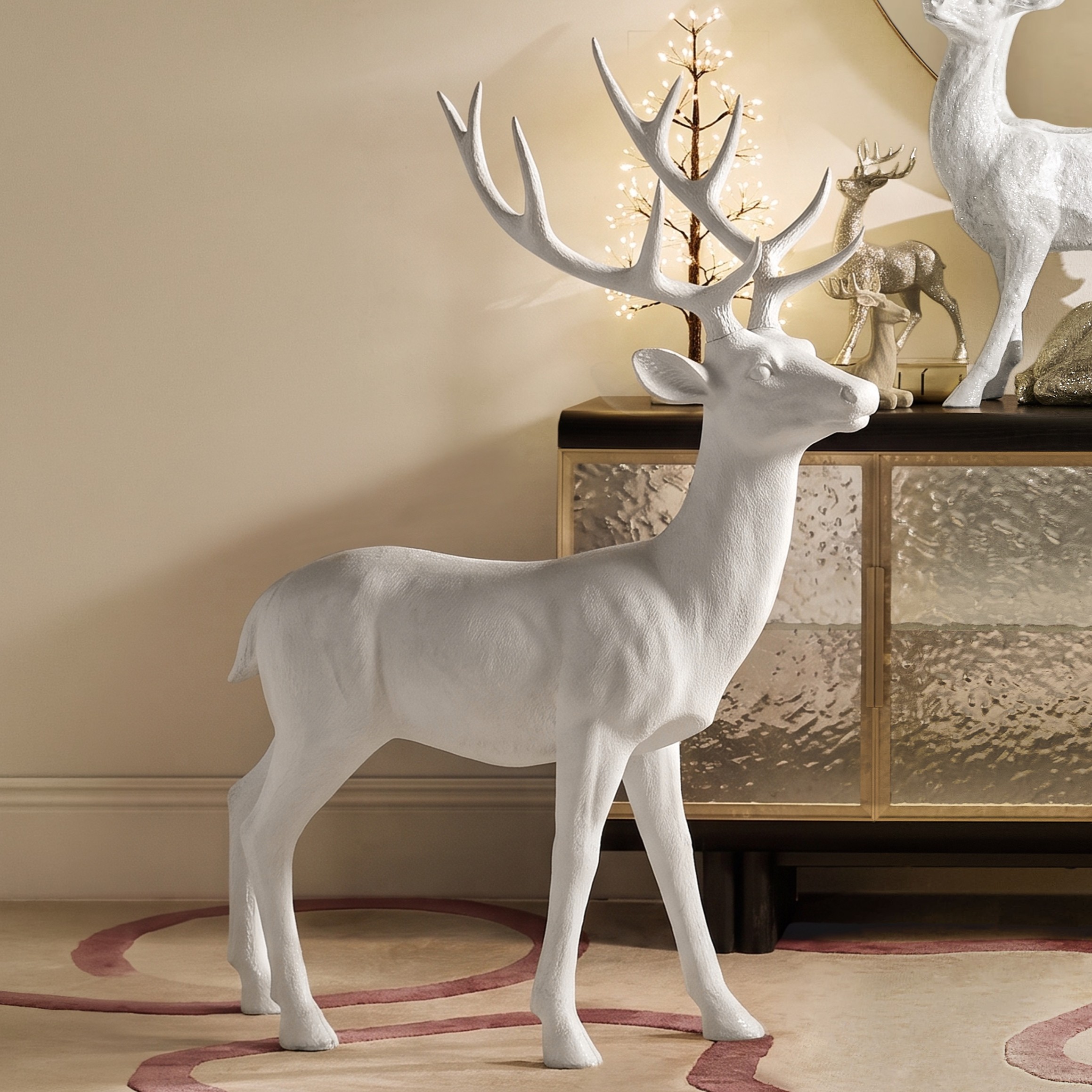
It does not. The Majestic Glitter Deer in white and champagne resin reads better against a dark mantel than a pale one, and at eleven inches deep it wants a shelf with real depth. If the room can take more, the Black Fancy Peacock runs sixty inches of layered feather, a piece you build a mantel around rather than add to one.
The Folia vase grounds the other end. Handblown glossy black glass, twenty-two inches tall and nearly fifteen wide, with the kind of organic form that reads as an object rather than a container. Leave it empty.
Not every Christmas mantel needs red. Some of the best ones have none.
The mantel is a decision. The table is the consequence.
How to decorate a table for Christmas
Build the centerpiece first and work outward. Keep everything in the middle of the table either below fourteen inches or above twenty-four so guests can see across it. Run candles in odd-numbered groups at staggered heights. Layer each place setting from the charger up, and repeat one finish from the mantel so the two ends of the room agree.
The height rule is the one people break. A centerpiece at eye level turns a dinner party into two separate conversations. Tapers are the exception and the reason candlesticks exist: a narrow stem at twenty inches reads as light, not as a wall.
A Christmas centerpiece does not have to be florals either. A single tall vase, a run of pillar holders, or a length of garland down the middle all do the job, and all of them clear faster when the food arrives. Start from the tableware already in the cupboard and add one piece that changes the register. Then set the place: charger, plate, glass, one texture underneath. On a long dining table, four layers is plenty.
Four Christmas tablescapes, each anchored by a centerpiece
Each of these is matched to one of the mantels above. Same palette, quieter volume.
Black and gold, matched to the nutcracker mantel
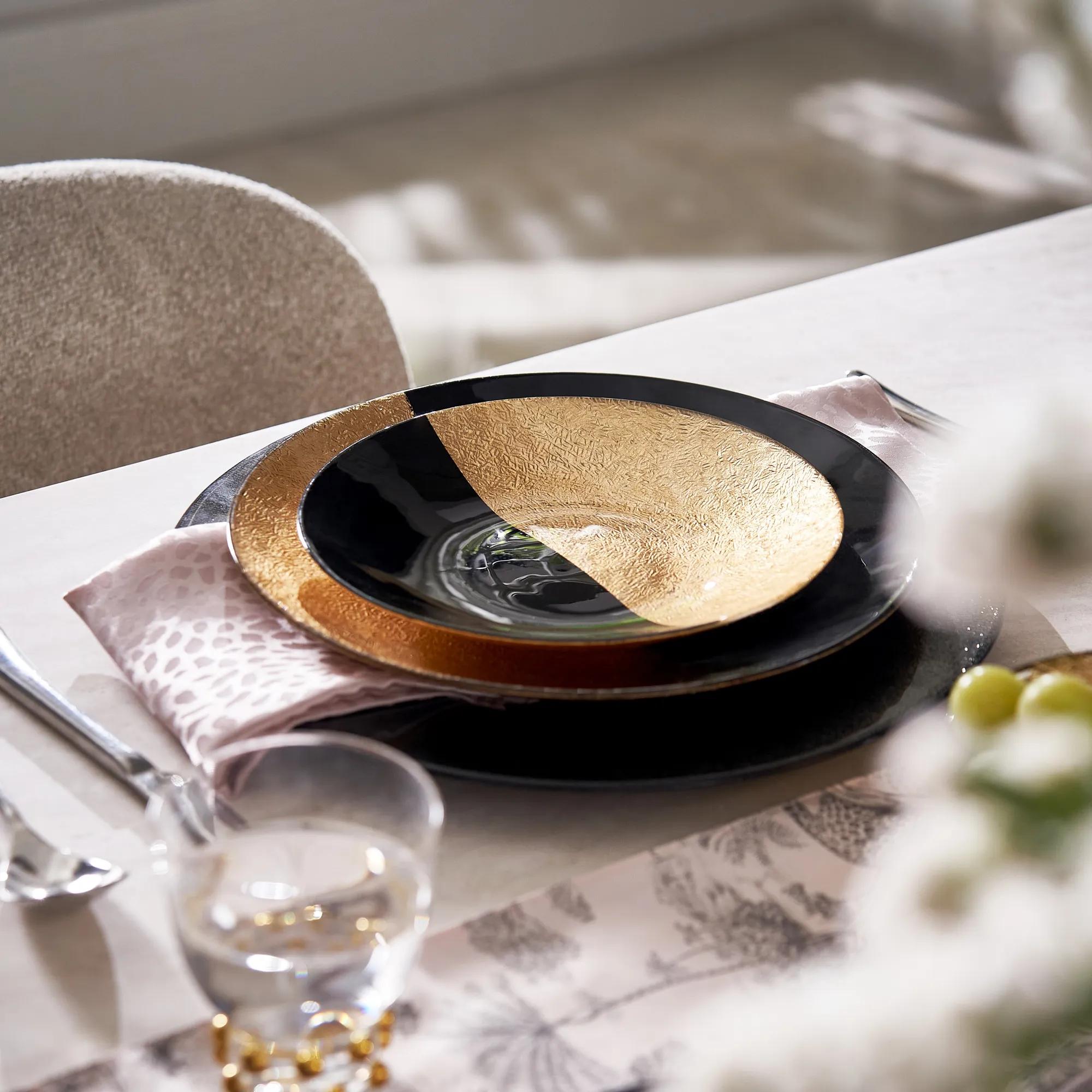
Two-tone glass is the fastest way to get formality without a full china cabinet. The Gemini dinnerware in black and gold layers over Spruzzo glass chargers, thirteen inches across with a metallic backing that catches light under the plate rather than around it.
For the centerpiece, the Trio Twist holders in twisted soft gold aluminum run fifteen, nineteen and a half, and twenty-three and a half inches. Set them slightly off-center and let the tapers carry the height so the sightline stays open.
It is the nutcracker mantel with the volume turned down, which is exactly what a table should be.
Fig and burgundy, matched to the dark mantel
Red at Christmas usually means one red. Going deeper, into fig and burgundy, gets you the warmth without the postcard.
The Bennet vase anchors the middle. Handblown glass in a column silhouette, nineteen and a half inches tall on a six and a half inch base, so it lifts above the sightline instead of blocking it. Fill it with burgundy amaranthus stems and let them cascade rather than stand up straight.
Down the length of the table, Porto pillar holders in faceted burgundy crystal at five and seven and a quarter inches. Two heights, repeated. Nothing else.
Pearl and white, matched to the pearl mantel
The same pearl garland that runs along the mantel runs down the center of the table, which is the most direct version of this whole idea and the easiest to execute in ten minutes.
Under it, Gemini dinnerware in white and gold keeps the setting bright without going stark. The Sophie toasting flutes bring the only real color change, a smoky charcoal glass with pearl detail that keeps the table from reading as a wedding.
Add alabaster taper holders in three heights. Solid stone with natural veining, so no two are quite the same, which is what stops an all-white table from looking printed.
Texture and plum, matched to the mirror mantel
When the mantel is doing something architectural, the table is better off soft.
The Micah runner is the whole look. A hundred and eight inches of faux Mongolian fur in smoked plum, backed in velvet, which gives a long table a spine and a color at the same time. Very little else is needed on top of it.
Beaded placemats at fifteen inches square sit over the runner and give each setting a hard edge against all that softness. Keep the candles low here, in pillars rather than tapers, so the texture stays the subject.
One material doing something unexpected is worth more than five doing what they are supposed to.
Making the mantel and the table read as one room
Matching is not the goal. Two surfaces that match exactly look like a set someone bought, which is the opposite of what a decorated house should feel like. What you want is agreement.
Three rules get you there:
- Repeat a material, not a motif. If the mantel has mirrored crystal, put crystal on the table. Do not put a second nutcracker on the table.
- Hold the metals to two. Gold and graphite, or gold and silver. A third finish is where a room starts to look accidental.
- Let the table be quieter. The mantel gets the scale and the sculpture. The table gets the same palette at half the volume, because people have to eat at it.
The test is simple. Stand in the doorway, take a photo on your phone, and look at it instead of the room. Anything that fights will fight in the picture first.
Mantel decor ideas that outlast the holidays
The best argument for spending real thought on a mantel is that most of it does not have to come down.
Anything structural stays. The mirror, the hurricanes, the vases, the alabaster and crystal candle holders. Those were never Christmas pieces, they were good pieces you used at Christmas. What leaves in January is the seasonal layer: the garland, the stockings, the nutcracker, the sequined stems.
Take those out and a well-built mantel does not look stripped, it looks edited. Swap the greenery for bare branches through February, then something living in spring, and the same three or four objects carry the shelf all year. If you want the longer version of that method, our guide to styling decorative bowls, vases and objects covers the arrangement rules underneath it.
Which is the quiet case for buying fewer and better in the first place. A mantel you can subtract from instead of dismantle is one you will still like in March.
Start with the mantel. Match the table. Then let the room be a room.
Frequently asked questions
How do you decorate a mantel without a garland?
Replace the horizontal line with a horizontal group. Three or four objects of graduated height, spaced along the shelf and clustered slightly to one side, do the same job garland does. Candle holders in odd numbers are the easiest version, and a single long low bowl or tray reads as intentional rather than empty.
What do you put on a mantel with a TV above it?
Work in a band rather than a stack. Keep everything under about twelve inches so nothing crosses the bottom of the screen, and use length instead of height: a low run of greenery, short pillar holders, small sculptural objects. The screen is already the anchor, so the shelf only has to soften its edge.
How do you decorate a round table for Christmas?
A round table wants one centered object, not a run, because there is no length to travel along. Repeat one small element at each place setting instead, so the eye moves around the circle rather than across it. If you are still deciding on the table itself, our guide to choosing a dining table shape covers how round and rectangular each entertain.
What goes on the hearth below the mantel?
Weight. A mantel arrangement that stops at the shelf looks top-heavy, so the hearth is where you put the things too large or too fragile for the ledge: oversized ornaments in a shallow tray, a tall vase, lanterns, a stack of logs. Keep it to two or three objects and leave the firebox itself clear.